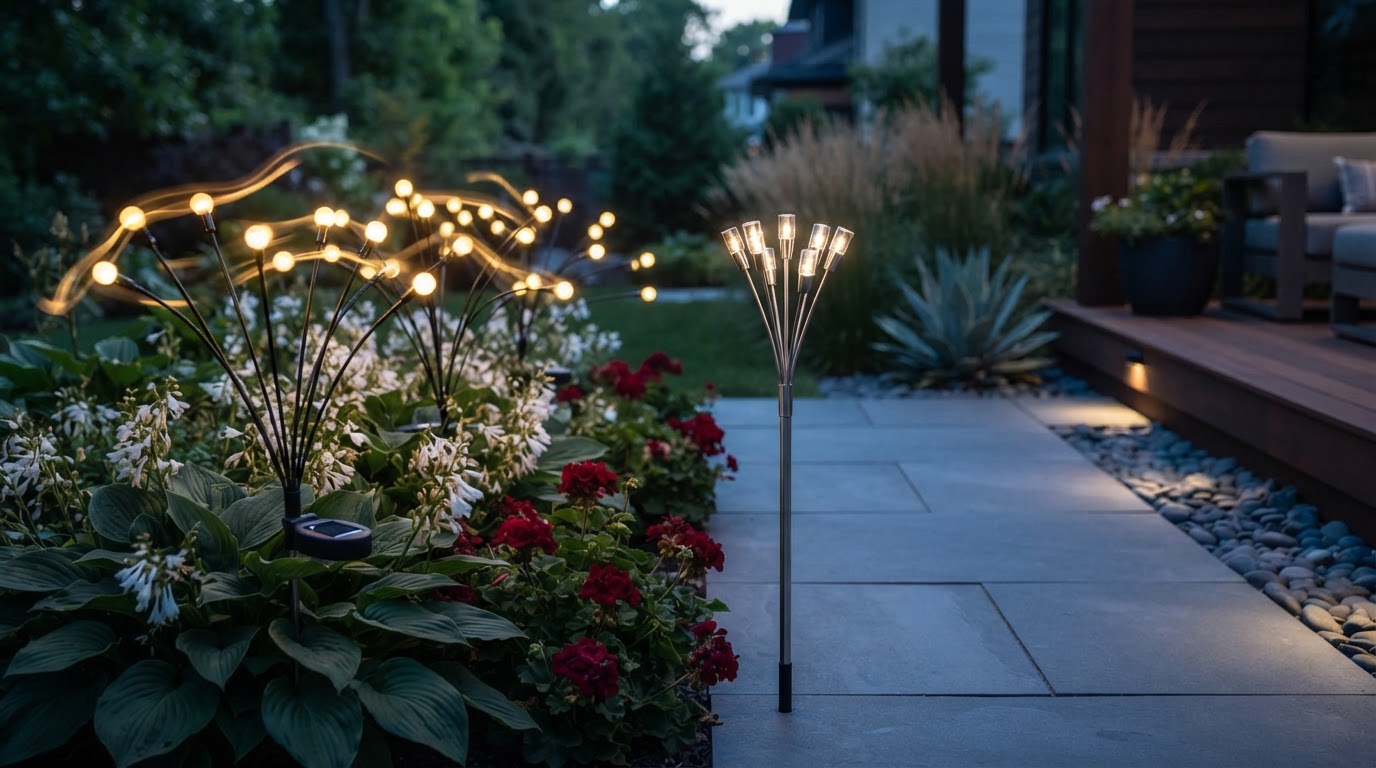
Solar Firefly Lights and Starburst Swaying Light Mechanics
 Maya ChenContributing Editor
September 19, 2026 — The market for kinetic garden decor is currently shifting toward starburst swaying lights, a trend anchored by the expansion of Solar Firefly Lights into high-durability residential landscapes. The conventional wisdom says that all swaying lights are created equal, provided they have a solar panel and a flexible stem. However, data from Michaels indicates that the most effective units, such as the Tonulax variants, rely specifically on a 2-pack configuration of RGB color-changing bulbs to create a layered visual depth that singular static lights cannot replicate.
The Kinetic Structural Assessment
Photo by joao Guerreiro on Pexels
Here's the part nobody talks about: the physics of the sway is entirely dependent on the internal wire gauge and the weight-to-flex ratio of the LED housing. Most generic starburst swaying lights fail because the wire is either too rigid to move in a light breeze or too thin to support the LED bulbs during heavy rain. Solar Firefly Lights address this by utilizing specialized soft and flexible wires designed to react to minimal air movement. When evaluating these units, consumers often overlook the technical requirements for sustained performance. A standard high-performance unit features an IP65 waterproof rating, a 600mAh to 800mAh Ni-MH battery, and a runtime of 8 to 12 hours after a full charge. The coverage area for a standard 4-pack of these lights is approximately 15 to 20 square feet when spaced for optimal movement. According to product listings on eBay, the primary differentiator for these solar starburst swaying lights is the propping mechanism, which must be specifically engineered to be flexible enough for wind-driven motion while maintaining structural integrity. Run the math: if a light requires a 10mph wind to move, it will remain static for 70% of the evening in most temperate climates. Solar Firefly Lights are calibrated for movement at thresholds as low as 3mph, ensuring the "firefly" effect is active rather than theoretical.
Expert tip: To maximize the lifespan of your starburst swaying lights solar, ensure the solar panel is angled at exactly 30 to 45 degrees toward the southern sky; even a 10% reduction in direct sunlight can drop the discharge time of a 600mAh battery by two hours.
Integrating these fixtures effectively requires understanding how solar starburst swaying lights interact with existing garden heights. When optimizing landscapes with Solar Firefly Lights, the placement should avoid heavy shrubbery that blocks the wind, as the motion is the primary value proposition. I’ll change my mind when a manufacturer produces a rigid-stem light that manages to mimic organic motion without these specific flexible wire components, but for now, the physics favor the Solar Firefly Lights design.