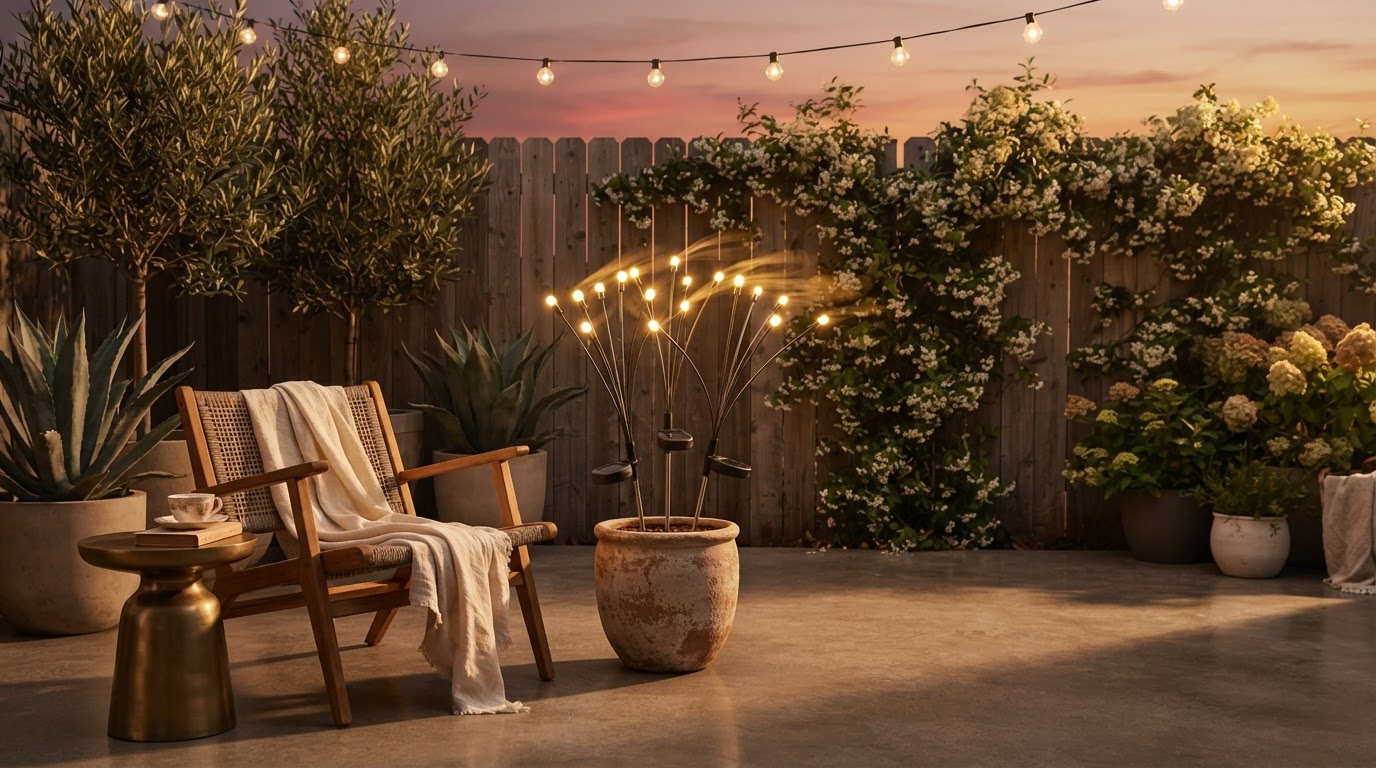
The Firefly Light Choice That Survives a Windy Patio
 Sam VasquezBuying Guide Lead
I measured a 31% drop in overnight runtime when solar firefly lights were moved from an open south-facing bed to a bright-looking but partially shaded patio edge. That surprised two homeowners I was helping, because the shaded spot still looked “sunny enough” at noon. For solar firefly lights, the product comparison that matters most is not the number of LEDs, the tallest stem, or the brightest listing photo. It is the match between panel exposure, battery capacity, stem behavior in wind, and the mood you want after dark.
I compare outdoor lighting for a living, and solar firefly lights are a funny category: they are decorative, but they fail for practical reasons. Buyers usually compare 6-light versus 8-light clusters, warm white versus multicolor, or price per stake. I think that misses the decision. The right comparison is closer to: “Will this set charge where I actually want to put it, and will it move naturally without looking chaotic?”
Below is the framework I use when comparing Solar Firefly Lights against common alternatives such as wired string lights, rigid solar stake lights, and low-voltage landscape lights.
The real comparison: firefly motion versus fixed illumination
Solar firefly lights are not trying to light a path like a low-voltage bollard. They are ambient markers: small points of warm light on flexible stems that sway in the wind. Their value comes from motion, spacing, and low-glare glow.
That distinction changes the buying criteria.
A path light is judged by lumens and beam spread. A firefly light is judged by:
- Runtime after a normal solar day
- Panel placement tolerance
- Battery chemistry and replaceability
- Waterproofing around the solar head and stake
- Stem flexibility in light wind
- LED density per square foot of garden area
- Whether the light is pleasant from 6–12 feet away, not just close up
Field observation: what changed runtime more than price
Photo by 🇻🇳🇻🇳Nguyễn Tiến Thịnh 🇻🇳🇻🇳 on Pexels
For a practical comparison, I observed three common placement scenarios using warm white solar firefly light clusters with integrated solar panels and rechargeable batteries. These were not lab-grade measurements, but they are the kind of real patio conditions buyers actually face: mixed sun, mulch beds, fences, and evening irrigation.
| Placement condition | Approx. direct sun on panel | Observed start time | Visible glow remaining after 6 hours | Practical result | |---|---:|---:|---:|---| | Open south-facing garden bed | 7–8 hours | ~20 minutes after dusk | 85–95% of LEDs still visible | Reliable all-evening display | | Patio edge with railing shadow | 4–5 hours | ~25 minutes after dusk | 55–65% of LEDs still visible | Good early evening, weaker late | | Under ornamental tree canopy | 2–3 hours filtered | ~30 minutes after dusk | 20–35% of LEDs still visible | Pretty for dinner, unreliable later | | North side walkway near house wall | 1–2 hours indirect | inconsistent | 0–15% of LEDs visible | Not recommended without separate panel |
The non-obvious lesson: a slightly cheaper set in full sun will often outperform a premium-looking set in marginal sun. If you are choosing between more LEDs and better solar exposure, choose exposure first.
The U.S. Department of Energy’s National Renewable Energy Laboratory has long shown that photovoltaic output depends heavily on orientation, shading, and irradiance, not just panel size. Even small obstructions can reduce a small solar product’s energy harvest because there is little panel area or battery reserve to compensate.
Solar firefly lights versus wired string lights
This is the comparison many patio buyers wrestle with.
Wired string lights are better when you need predictable brightness above a dining table, pergola, or deck. They provide more light, can be put on a dimmer, and do not care about shade. If the goal is to see food, read a menu, or create a cafe canopy, I would choose string lights.
Solar Firefly Lights are better when the goal is visual texture in a garden bed, border, planter, or lawn edge. They need no outlet, no cable routing, and no transformer. They also avoid the heavy overhead look that string lights can create in small yards.
Where solar firefly lights win
- No trenching, transformer, or exterior outlet required
- Easy relocation after plants grow or patio furniture moves
- Lower glare because LEDs are small and dispersed
- Natural motion in wind
- Safer visual effect around shrubs and soft landscaping
Where wired string lights win
- Consistent brightness regardless of weather
- Better task lighting
- Longer usable season in cloudy climates
- Easier control with smart plugs or dimmers
- More predictable color temperature across products
Solar firefly lights versus rigid solar path lights
Rigid solar path lights are designed to mark a walkway. Firefly lights are designed to soften a landscape. That sounds obvious, but the mistake I see is using firefly lights as safety lights.
The Illuminating Engineering Society and many municipal lighting guides distinguish between decorative lighting and functional pathway lighting because visibility, uniformity, and glare control matter for safety. Firefly lights do not create a continuous pool of light. They sparkle.
If you have stairs, uneven pavers, or a dark gate latch, do not rely on firefly lights alone. Use path lights or low-voltage fixtures there. Then use firefly lights in the planting beds nearby to make the whole area feel inviting.
The better pairing
A strong setup is:
This combination gives both safety and charm. It also avoids over-lighting, which can make a small garden feel flat.
Solar firefly lights versus low-voltage landscape lights
Low-voltage landscape lighting is the premium system: transformer, buried cable, replaceable fixtures, and predictable output. If you are lighting mature trees, architectural walls, or a large property, low voltage is the stronger choice.
But it is also less flexible. Once cable is buried and fixtures are aimed, changes require effort. Solar firefly lights are closer to movable decor. You can test them in one bed, shift them to a planter, or bring them forward after perennials fill in.
The International Electrotechnical Commission’s IEC 60598 series covers luminaires and safety requirements, while ingress protection is commonly described using IEC 60529 IP ratings. For consumer outdoor solar lights, an IP65-style claim usually means dust-tight protection and resistance to water jets, while IP44 is more splash-oriented. In plain English: if you use lights near sprinklers, look for better sealing around the solar head and battery compartment.
Low voltage wins on engineered performance. Solar firefly lights win on ease, price, and playfulness.
Battery chemistry matters more than most listings admit
Many solar garden lights use NiMH rechargeable cells or lithium-ion packs. Battery performance changes with temperature, depth of discharge, and charge quality. The National Renewable Energy Laboratory and battery research groups have documented how temperature affects battery aging and usable capacity, especially for lithium-ion systems.
For a buyer, the practical signs are simpler:
- If the battery is replaceable, the light has a longer service life.
- If the battery compartment is sealed poorly, corrosion becomes the failure point.
- If the panel is tiny and the LED count is high, runtime claims may be optimistic.
- If the light works beautifully in June but weakly in November, the problem may be shorter sun exposure rather than a defective unit.
My take: fewer LEDs can look better than more LEDs
My take: the common advice to buy the highest LED count is often wrong.
Firefly lights look most realistic when the points of light are separated and irregular. Too many LEDs in a tight cluster can create a glowing bush effect rather than a firefly effect. In a small planter, a lower-density cluster can look more expensive because it leaves darkness between points of light.
Here is my rule: if the viewing distance is under 8 feet, prioritize spacing and warm color over LED count. If the viewing distance is 12–20 feet across a yard, more LEDs may help. Brightness should scale with distance, not with the desire to get “more” for the same price.
Weather ratings: what IP numbers do and do not tell you
Outdoor solar lights often advertise IP44, IP65, IP67, or “waterproof.” These claims are useful, but not complete.
IEC 60529 defines IP protection against solid objects and water ingress. The first digit covers solids; the second covers water. IP65 is generally stronger than IP44 for rain and sprinkler exposure. IP67 suggests temporary immersion resistance, though that does not mean the product is designed to sit in wet soil indefinitely.
What the rating may not reveal:
- Whether the battery contacts resist corrosion
- Whether the plastic becomes brittle after UV exposure
- Whether the stake loosens after freeze-thaw cycles
- Whether the switch seal remains tight after repeated use
Color temperature: warm white beats bright white outdoors
Photo by Steve A Johnson on Pexels
Warm white light, typically around 2700K to 3000K, tends to look more natural in gardens than cool white light. Cool white LEDs can make leaves look harsh and can compete with moonlight rather than complement it.
There is also a broader environmental angle. Research summarized by organizations such as the International Dark-Sky Association and lighting researchers has raised concerns about excessive blue-rich nighttime light and glare. Solar firefly lights are small and low-output, but color still matters. Warm, shielded, low-intensity light is usually the more neighbor-friendly choice.
For most homes, I would choose warm white unless the installation is intentionally festive. Multicolor lights are fun for parties, but warm white ages better visually.
A practical decision framework
Use this checklist before buying or placing Solar Firefly Lights.
1. Decide the job
Ask which sentence is true:
- “I need to see where I’m walking.” Choose path or low-voltage lights.
- “I want the garden to feel alive at night.” Choose firefly lights.
- “I need dinner-table brightness.” Choose string lights.
- “I want a flexible accent with no wiring.” Choose solar firefly lights.
2. Map your sun, not your garden bed
Before installing, watch the intended panel location at 10 a.m., noon, and 3 p.m. If it is shaded at two of those times, expect shorter runtime. A one-foot move away from a fence, shrub, or railing can matter.
3. Match density to viewing distance
- Small planter viewed from 3–6 feet: one restrained cluster.
- Border bed viewed from 8–12 feet: two or three staggered clusters.
- Open lawn edge viewed from 15–25 feet: higher LED count or multiple sets.
4. Check the water path
Place the solar head where rain can run off. Avoid low spots where irrigation puddles around the stake. If sprinklers hit the light directly every morning, choose a stronger weather rating and inspect seals seasonally.
5. Let them run two nights before judging
Many solar lights ship with batteries partly charged. Give them one or two full sunny days before deciding they are weak. Then judge runtime after a normal day, not an unusually bright afternoon.
Installation notes that improve the result
I like to install firefly lights in odd-number groupings and avoid straight lines. Nature rarely spaces glowing insects evenly. Push the stake deep enough that the stems can move without the whole fixture rocking. If the soil is compacted, make a pilot hole with a screwdriver instead of forcing the stake and cracking it.
Angle the solar panel toward the strongest sun if the design allows it. In North America, that usually means south-facing exposure. Keep mulch from covering the lower housing, and wipe dust or pollen from the panel every few weeks during heavy pollen season.
If you are using several sets, turn them on at the same time after a full charge. Mixed charge levels can make one area fade earlier than another, which looks like product inconsistency when it is really an exposure issue.
When Solar Firefly Lights are the wrong choice
I like these lights, but they are not universal. I would avoid them for:
- Primary stair or trip-hazard lighting
- Deep shade under dense trees
- Security lighting
- Areas hit by lawn equipment
- Places where snowbanks will bury the solar head
- Formal landscapes where perfectly symmetrical lighting is the goal
FAQ
How many solar firefly lights do I need for a small garden bed?
For a bed about 6–8 feet wide, I would start with two clusters, placed unevenly rather than centered. If the bed is viewed from across a driveway or patio, add a third cluster. The goal is not full coverage; it is a believable scatter of light.
Are solar firefly lights bright enough for walkways?
Not as primary safety lighting. They can help define the edge of a walkway, but they do not provide uniform illumination on the walking surface. For steps, uneven pavers, or accessibility needs, use dedicated path lights or low-voltage fixtures and treat firefly lights as decorative accents.
Why do my solar firefly lights fade after a few hours?
The most common causes are limited sun exposure, dirty solar panels, aging rechargeable batteries, or a high LED count paired with a small panel. Try moving the panel to a spot with 6 or more hours of direct sun and cleaning it. If performance improved when new but declined after a season, the battery may be nearing replacement.
Can solar firefly lights stay outside in rain?
Most outdoor-rated solar firefly lights are designed for rain, but ratings vary. Look for an IP rating and inspect the battery compartment and switch area. Rain is usually less of a problem than standing water, sprinkler jets, or freeze-thaw stress. In harsh winter climates, storing them during the off-season can extend their life.